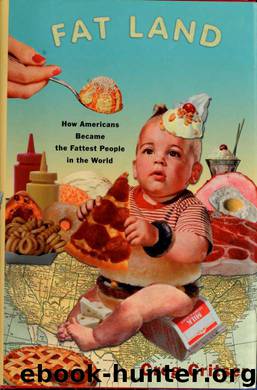
Fat land : how Americans became the fattest people in the world by Crister Greg
Author:Crister, Greg
Language: eng
Format: epub
Tags: Obesity
Publisher: Boston, MA : Houghton Mifflin Company
Published: 2003-08-16T04:00:00+00:00
FAT LAND
of the children were obese — 21 percent of the boys and 9 percent of the girls.
A sensitive, elegant writer who had originally been attracted to the study of nutrition through an interest in impoverished Third World populations, Crooks drew from her work three important conclusions: One, that poor children in the United States often face the same evolutionary nutritional pressures as those in newly industrializing nations, where traditional diets are displaced by high-fat diets and where, as in the United States, laborsaving technology reduces physical activity. Second, Crooks found that "height and weight are cumulative measures of growth ... reflecting a sum total of environmental experience over time." Last, and perhaps most important, Crooks concluded that while stunting might be partly explained by individual household conditions — income, illness, education, and marital status — obesity "may be more of a community-related phenomenon." A town's physical and economic infrastructures — safe playgrounds, access to high-quality, low-cost food, and transportation to recreation facilities — were the real determinants of physical activity levels, and, hence, weight. "Given that as a nation, we are trying to improve public health by promoting more healthful behaviors," she concluded, "this research indicates that nutrition education efforts might benefit from a greater focus on children.... These efforts should also address the particular concerns of communities and families in poverty."
Poverty. Class. Income. Over and over, these emerged as the key determinants of obesity and weight-related disease. True, there was a new trend that saw significant numbers of the middle and upper middle class also experiencing huge weight gains. But the basic numbers were — and are — clear and consistent; the largest concentrations of the obese, regardless of race, ethnicity, and gender, reside in the poorest sectors of the nation — among the chronically impoverished (from Appalachia to the rural South), among the working poor (from L.A. barrios to New York's Little
Download
This site does not store any files on its server. We only index and link to content provided by other sites. Please contact the content providers to delete copyright contents if any and email us, we'll remove relevant links or contents immediately.
The Brazilian Economy since the Great Financial Crisis of 20072008 by Philip Arestis Carolina Troncoso Baltar & Daniela Magalhães Prates(138779)
International Integration of the Brazilian Economy by Elias C. Grivoyannis(111057)
The Art of Coaching by Elena Aguilar(53249)
Flexible Working by Dale Gemma;(23292)
How to Stop Living Paycheck to Paycheck by Avery Breyer(19727)
The Acquirer's Multiple: How the Billionaire Contrarians of Deep Value Beat the Market by Tobias Carlisle(12327)
Thinking, Fast and Slow by Kahneman Daniel(12301)
The Radium Girls by Kate Moore(12028)
The Art of Thinking Clearly by Rolf Dobelli(10487)
Hit Refresh by Satya Nadella(9132)
The Compound Effect by Darren Hardy(8965)
Tools of Titans by Timothy Ferriss(8393)
Atomic Habits: Tiny Changes, Remarkable Results by James Clear(8343)
Turbulence by E. J. Noyes(8047)
A Court of Wings and Ruin by Sarah J. Maas(7844)
Change Your Questions, Change Your Life by Marilee Adams(7780)
Nudge - Improving Decisions about Health, Wealth, and Happiness by Thaler Sunstein(7706)
How to Be a Bawse: A Guide to Conquering Life by Lilly Singh(7486)
Win Bigly by Scott Adams(7195)
